
The Human Organisation
What a 'company' actually is, and how people are with each other

At the psychological level, the human organisation is unavoidably pathological. Where it succeeds, it does so despite itself, not because of it.
Last month, I penned a short article on my slowly changing opinion regarding asset quality versus management quality. The TL;DR version is that both matter. The TL;DR insight is that management dexterity can be the difference between success and mediocrity. Not all that ground-breaking, I’m afraid.
In passing, I mentioned the pathological nature of the “human organisation.” I think most people are acutely aware of this but are reticent to acknowledge it, because to do so would be to tacitly admit one’s own complicity. Well, because I now write from an ivory tower, it’s something I think I can reasonably opine on.
Structures of Corporate Power
As a young professional, I was completely underprepared for the working world. Attending an all-boys private school, playing rugby, lifting weights, and writing law and history assignments does not constitute a practical entrée to the “real” world in any meaningful way. I enjoyed the now-antiquated upbringing of an old British imperial schoolboy—albeit out in the colonies. Lacking, however, the country estate and associated trappings of that bygone era, I desperately searched for ways to make sense of the modern corporate world.
Books like Guns, Germs, and Steel provide a useful overlay for understanding the foundational ideas of our society at a very high level, but they lack the micro-detail necessary to be helpful in day-to-day life. I found useful insights in much less obvious places. One of the best sources of forbidden knowledge in this regard was the idea of “selectorate theory,” developed by Bruce Bueno de Mesquita and Alastair Smith in The Dictator’s Handbook.
The book is essentially a discussion of how leaders come to power and how they maintain it. The authors, proponents of game theory, view leadership as the relationship between a leader and those whose support is essential in maintaining that position. Economic decisions made by a regime are made under this framework. A would-be leader must promise potential supporters economic benefits to come to power, and she must deliver those benefits to remain in power. The politics of the human organisation can be seen through the lens of three essential groupings: the “leader,” the “essentials” (those who can actually propel a leader to power), and the “interchangeables” (from whom the essentials are typically chosen).
The book spends a large amount of time discussing the dynamics of how each grouping changes depending on whether one is dealing with a “large-coalition” government (what we might describe as a modern representative democracy) or a “narrow-coalition” government (an authoritarian regime). The larger the group you need to appease to assume power, the more likely you are to allocate resources efficiently by delivering public goods. Conversely, the narrower the group required to achieve leadership, the more efficacious private goods (i.e., bribes) become. Most human organisations—especially corporations—are examples of narrow-coalition governments. The leader is usually, though not always, the CEO. She relies on the board of directors (the essentials) for appointment to that position. The board is elected by the shareholders, who are, of course, the interchangeables.
In Peter Thiel’s Zero to One, he isolates these groupings as “possession,” “governance,” and “ownership.” A company is possessed by its employees, who control its actions on a day-to-day basis; they are appointed by the board; and shareholders (large and small) actually own the company. While Thiel viewed the corporation through the prism of how it could be successful, Bueno de Mesquita and Smith view “success” simply as remaining in power.
Buffett, as usual, is an example of success in both regards. His successor, on the other hand, is almost the perfect anti-example. If we set aside his more recent donations, Buffett historically controlled something like ~40% (someone will no doubt correct me) of the voting rights in Berkshire Hathaway through his ownership of the Class A shares. He also enjoyed close personal relationships with other significant holders of the stock (often enjoying their proxies), which allowed him to effectively control the company since taking it over in the late 1960s. He is the Chairman of the Board, has appointed loyalists to it—including at times his wife, children, lifelong friends, and business partners—and is also CEO, controlling the company’s use of funds and appointing key management personnel. He is, in short, a very well-insulated leader heading what might otherwise be termed a dictatorship. An enlightened despotism, certainly, but no one could accuse Berkshire of being a democracy.
Now that Buffett has moved into semi-retirement, it’s difficult for him to have a true “successor” in his own image. Greg Abel may be smart, respected, and capable, but he doesn’t own 40% of the company. Big blocks of the stock will be owned by the Gates Foundation and the foundations run by Buffett’s children. Nor will Abel be able to easily control the board; I believe Buffett’s eldest son, Howard, will still succeed to the Chairmanship. Abel is simply a leader and a minor shareholder, enjoying possession of one of America’s largest conglomerates. While Buffett lives, Abel can enjoy the protection of the man who still dominates each facet of Berkshire’s power structure, and perhaps for a time thereafter he can enjoy the fading nimbus of Buffett’s legendarium. After that, his position will understandably be much, much weaker than his predecessor’s.
The Dictator’s Handbook actually discusses what a leader should do in such a scenario to maximise their own power. Politics obviously doesn’t draw its constituents from those who have an economic stake in the country; in the West, it actively seeks to marginalise their influence. Yet the purely political example is still appropriate for this scenario. The goal for a leader insecure in power is to enlarge the number of essentials and expand the pool of interchangeables accordingly. The most logical move for Abel would be to enlarge the number of board members as much as possible and appoint faithful lackeys to those positions. Thiel’s observations on board sizes are especially insightful here:
A board of three is ideal. Your board should never exceed five people, unless your company is publicly held. (Government regulations effectively mandate that public companies have larger boards —the average is nine members.) By far the worst you can do is to make your board extra large. When unsavvy observers see a nonprofit organization with dozens of people on its board, they think: “Look how many great people are committed to this organization! It must be extremely well run.” Actually, a huge board will exercise no effective oversight at all; it merely provides cover for whatever microdictator actually runs the organization.
Abel would be well advised to break Buffett’s long-time practice of not remunerating board members. Buffett was able to get away with this because he rewarded his followers with exceptional stock-price appreciation. The Berkshire of today is in no position to replicate Buffett’s legendary record, but it does have access to substantial cash flow. Having stacked the board with his loyalists, Abel should then secure the Chairmanship at the earliest opportunity. Having secured possession and governance of the company, the only way he could be removed would be if enough of the disparate post-Buffett ownership base banded together to seize control of the board—a tall order, in my opinion. Abel is not Buffett and should not act like him if he wants to succeed in leadership.
All of this feels somewhat slimy, doesn’t it? Well, that’s because it is. And that’s politics. My constant refrain is that corporate success happens despite the many forces pushing it toward mediocrity and, ultimately, failure. In Berkshire’s case, decades of success came about only because of a very unusual arrangement of factors. Some people say “success doesn’t happen by accident”—I’d argue that the environment that allows for success often does.
Coming to Leadership
Selectorate theory explains how structures of power within an organisation interact, but it rather brushes over how a leader comes to power and how one might understand the micro-dynamics of those in possession of the company. One of my more enjoyable reads during university was Coup d’État: A Practical Handbook by Edward N. Luttwak. A marvellous read, by the by—though in retrospect I suspect my reading list may have landed me on an intelligence watchlist.
Luttwak’s main premise was military and political; he was not interested in the corporate sphere. Some of his insights, however, transfer readily. His essential point is that to overthrow the state, and subsequently come to power, one must use the inertia of the state against itself. Since the advent of modern communications and transportation, as well as automatic weapons, violent revolution has become virtually impossible. Very few governments have been overthrown in such a manner since the post-war period. In this context, insurgents must corrupt the smallest possible part of the state to seize the levers of power. Politically, this means controlling key transportation infrastructure, the media, and the physical locations from which power is exercised (parliament, the bureaucracy, the courts, and/or the executive arm of government).
One must also “neutralise” the former leaders. After that is achieved, a new leader appoints their supporters to key positions.
In the modern corporate context, it’s not necessary to arrest your predecessor and arrange show trials, however much we might like to. During my time working for an offshoot of the Brisbane City Council (you’d be hard-pressed to find a more political organisation), I saw these patterns repeat. Being a lowly grunt, I was well placed to observe the many political battles fought by those aiming for local-government greatness.
When I arrived, this particular quango (not really a term in Australia, but appropriate here) had been headed by the same man who had set it up more than a decade earlier. He enjoyed widespread internal acclaim. I have since come to understand that when you’ve appointed nearly everyone in an organisation, goodwill flows freely. He led an organisation-wide weekly meeting where employees enjoyed free food and beverages (thanks, ratepayers!), plastered his face all over the weekly email (control of the media), and regularly lunched with the Lord Mayor (the source of money and power). He was also notably inaccessible. I’m reminded of the sign in Buffett’s foyer:
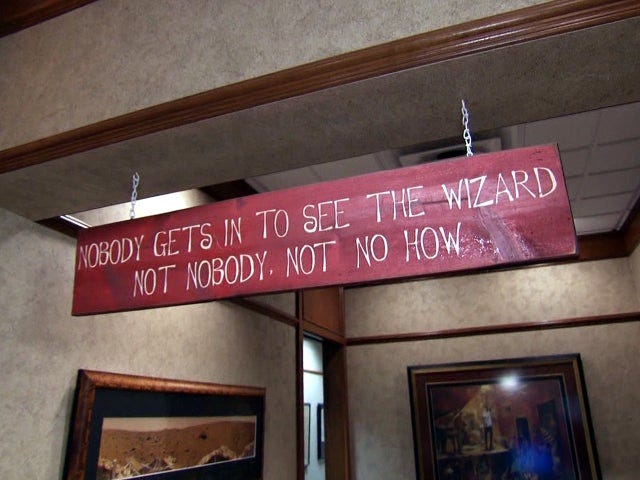
He ultimately retired about a year into my tenure, riding into the sunset with one of those taxpayer-subsidised pensions that would make even the most ardent leftist queasy. His successor did not enjoy similar longevity. In essence, every power transition is a coup. Whether at the highest level or the lowest, the forces compelling people to act are the same. His successor was surrounded by executives who had been rivals for the top job and took no steps to remove them. The chairman of the board was a friend of the former leader but was himself fully independent as the CEO of one of Brisbane’s most prominent law firms. I rarely saw him at weekly meetings, nor was he prominent in internal communications. He was also not well acquainted with the Lord Mayor—a major issue. When COVID hit, he was forced to fire roughly 300 staff members and was subsequently scapegoated by the Lord Mayor. He was replaced by a very ambitious subordinate who had previously competed for the same job.
I saw the same pattern repeat—successfully this time—with my first direct report. When she took control of the division, she immediately fired three insubordinate staff members, hired six new employees, and promoted several of us. She cultivated a wide acquaintance with those further up the food chain. By contrast, when our division was placed under a new executive, the failure sequence repeated: the new executive preserved the status quo, failed to cultivate favour either upward or downward, and was eventually removed after a staff rebellion.
Again—pathological.
Inside the Organisation
Rounding out my education in the dark arts of the human organisation were a series of essays I discovered during COVID titled The Gervais Principle by Venkatesh Rao. It is the single most insightful piece of writing I have encountered in this space. Rao opens the first essay with the following:
Now, after four years, I’ve finally figured the show out. The Office is not a random series of cynical gags aimed at momentarily alleviating the existential despair of low-level grunts. It is a fully realized theory of management that falsifies 83.8% of the business section of the bookstore. The theory begins with Hugh MacLeod’s well-known cartoon, Company Hierarchy (below), and its cornerstone is something I will call The Gervais Principle, which supersedes both the Peter Principle and its successor, The Dilbert Principle. Outside of the comic aisle, the only major and significant works consistent with the Gervais Principle are The Organization Man and Images of Organization.
The complete essay is essentially an abnegation of popular management theory. You’ve likely heard the phrase “people rise to the level of their incompetence” (the Peter Principle). Rao argues that this is false. Instead, the human organisation—at least at the employee level—can be broken into three parts:
Sociopaths
Clueless
Losers
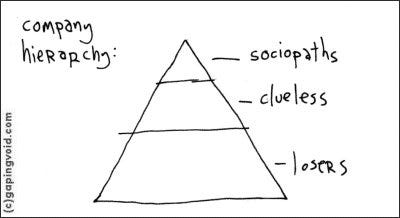
Sociopaths constitute upper management; the clueless comprise what we might describe as middle management; and losers (in the economic sense) are the rest of the rank-and-file.
The underlying premise of the organisation is to:
identify losers who can become sociopaths;
identify the “useful idiot” losers who can become middle managers;
leave the rest of the rank-and-file to fend for themselves.
There are two paths for progression. First, a low-level employee, sensing they’ve made a poor economic bargain, may begin taking high-risk gambits to ascend in the company’s hierarchy. Depending on luck, timing, and skill, they may or may not succeed. Second, a low-level employee who cannot or will not acknowledge the futility of their position may instead work very hard—making a bad bargain worse. Sensing their easily manipulable nature, sociopaths will “promote” such people into middle management. This is, of course, a poisoned chalice: the purpose of clueless middle management is to act as a prophylactic buffer for the schemes of sociopathic senior leaders. The clueless are the device used by upper management to enact layoffs, demotions, restructurings, and to take the fall for high-risk strategies gone awry.
Sociopaths, in their own interests, knowingly promote over-performing losers into middle management, groom under-performing losers into sociopaths, and leave the average, bare-minimum-effort losers to fend for themselves.
The clueless layer is essential. The highest and lowest levels of employees actually speak the same unvarnished language. To avoid what would otherwise be opportunities for considerable internal friction, clueless intermediaries are required to relay management directives in a way that diffuses these tensions. The trajectory of these three personas describes the lifecycle of a company:
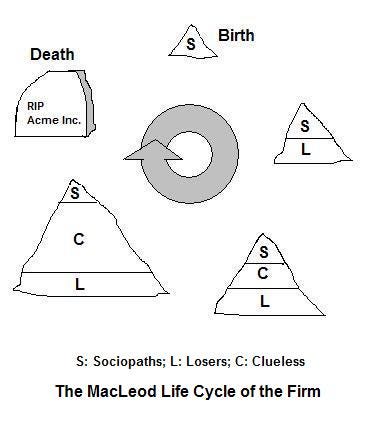
Coincidentally, this is where capital comes in:
The Sociopaths defeated the Organization Men and turned them into The Clueless not by reforming the organization, but by creating a meta-culture of Darwinism in the economy: one based on job-hopping, mergers, acquisitions, layoffs, cataclysmic reorganizations, outsourcing, unforgiving start-up ecosystems, and brutal corporate raiding. In this terrifying meta-world of the Titans, the Organization Man became the Clueless Man. Today, any time an organization grows too brittle, bureaucratic and disconnected from reality, it is simply killed, torn apart and cannibalized, rather than reformed. The result is the modern creative-destructive life cycle of the firm, which I’ll call the MacLeod Life Cycle.
Capitalism—and by extension the organisation—is naturally dysfunctional. It succeeds only by letting its failed experiments expire. In any company, a small handful of people must be responsible for propelling it forward and producing the essential good it exists to create (economic value). This contrasts sharply with the great bulk of the employee base who are, strangely enough, unknowingly obstructionist at best and antagonistic at worst to that aim.
Where a particular management team sits in the above pyramid is fluid. As mentioned, some executives truly occupy the highest levels (Buffett). Some are simply clueless intermediaries used by board members and major shareholders.
Practical Takeaway
How does one overcome these obstacles?
My answer: you don’t. We are always on the lookout for things that exist and persist despite the entropy inherent in the physical world. Buffett’s model was to centralise effective control in the hands of a very capable manager. That same control was then delegated further down the chain. How that control will persist after he leaves this world is a matter of debate. Dye & Durham provides almost the perfect anti-example. Despite reasonably good assets, a complete lack of control and direction will likely see it bankrupted, as sociopaths and loser-employees have largely left the company.
I see the possibility of an unaccountable CEO dictatorship at Dalrymple Bay Infrastructure. No longer encumbered by Brookfield’s effective governance, its relatively new CEO enjoys a widely dispersed ownership base and a less concentrated board. With his hand on the tiller, he appears to be pursuing a programme of leveraged corporate M&A. The likelihood that the MacLeod life cycle is triggered (more and more middle-management stooges to temper an expanding employee base) is not impossible.
The trick is simply to be aware—and to hope to ride the exceptions for as long as possible.
Forbes.